Most interesting facts about the North Star and where it is most visible in Europe
7/9/20263 min read

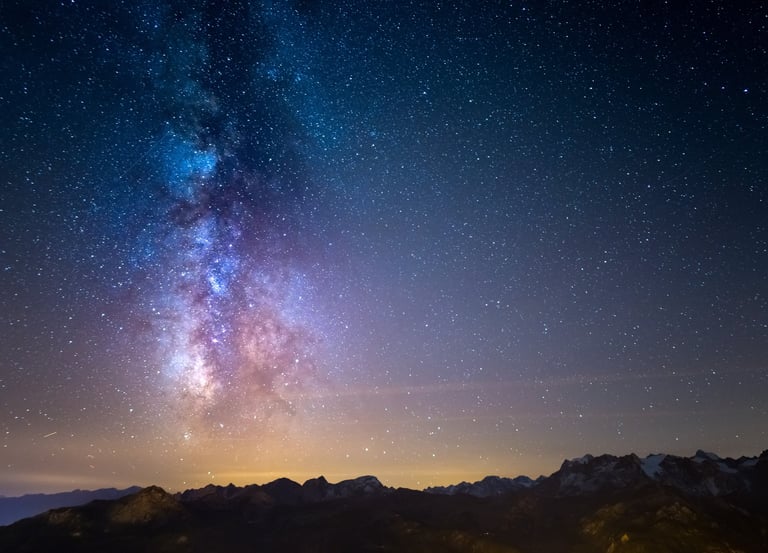
The North Star, known as Polaris, has fascinated humans for millennia. Revered as a steadfast guide in the night sky, Polaris is more than just a bright point of light—it’s a celestial marvel packed with intriguing facts and a crucial role in navigation. If you’re in Europe and curious about where and how to catch this stellar beacon, you’re in the right place. Let’s explore some of the most captivating facts about Polaris and reveal the best spots across Europe to see it shining brightly.
Fascinating Facts About the North Star
1. Polaris Is Nearly Aligned with Earth's Axis
Polaris’s claim to fame is its proximity to the North Celestial Pole, sitting almost exactly above Earth's rotational axis. This means Polaris appears almost fixed in the northern sky, while other stars seem to circle around it. This unique position has made it the ultimate celestial compass for travelers over centuries.
Polaris Is Actually a Triple Star System
What looks like a single bright star to the naked eye is actually a system of three stars gravitationally bound together. The primary star, Polaris Aa, is a supergiant approximately 2,500 times more luminous than the Sun. Its companions orbit it closely, making Polaris a fascinating target for astronomers.
Distance and Brightness
Polaris is located about 430 light-years away from Earth. Despite this vast distance, it remains one of the brightest stars in the northern sky, due to its massive size and intrinsic brightness.
Polaris’s Role in Navigation
Before modern GPS technology, sailors and explorers depended on Polaris to find true north. By measuring the angle between Polaris and the horizon, one could determine their latitude in the Northern Hemisphere—a technique still taught in navigation today.
Polaris’s Position Reflects Your Latitude
The altitude of Polaris above the horizon closely matches the observer’s latitude. For example, at 50° north latitude, Polaris appears about 50° above the horizon. This makes Polaris a natural tool for orienting oneself anywhere in the northern hemisphere.
Where Can You See the North Star Most Clearly in Europe?
Polaris is visible across much of Europe, but its position and visibility vary by location and season. Here’s where you can find it most easily:
1. Northern Europe: Best Visibility
Scandinavia (Norway, Sweden, Finland): Being closer to the Arctic Circle, Polaris appears higher in the sky here—often nearly overhead in northern parts.
Iceland: With its dark skies and northern latitude, Iceland offers spectacular views of Polaris and the surrounding stars.
2. Central Europe: Moderate Visibility
Countries like Germany, Poland, and the United Kingdom have good visibility of Polaris. It sits at a comfortable altitude above the northern horizon, usually easy to spot on clear nights.
3. Southern Europe: Low on the Horizon
In places like Spain, portugal and Greece, Polaris appears much closer to the horizon, making it a bit trickier to spot, especially in areas with hills or buildings blocking the view.
However, with clear skies and open northern views, it’s still visible year-round.
You can also check out our comprehensive list of top secret places to stargaze in Europe.
Tips for Spotting Polaris in Europe
Find a location with a clear view of the northern horizon—avoid city lights and tall obstructions.
The best time to see Polaris is during moonless nights or when the moon is low to reduce light interference.
Use landmarks like Cassiopeia’s W-shaped constellation as a pointer to locate Polaris quickly.
For the most dazzling experience, head to dark-sky parks or rural areas known for minimal light pollution, such as the Scottish Highlands or the Swedish Lapland.
Bonus: Polaris in European Culture
Polaris has long held a special place in European culture and folklore, symbolizing guidance, stability, and hope. In ancient times, sailors and travelers relied on the North Star not only for navigation but also as a symbol of safe passage and homeward journeys. Many European maritime legends and stories reference Polaris as a steadfast guardian in the dark, uncharted waters.
Beyond navigation, Polaris was often seen as a cosmic anchor, representing constancy in a changing world. From medieval manuscripts to poetic works and folk songs, the North Star inspired countless tales that celebrated its unwavering presence in the night sky. Its importance transcended science and became a cultural icon, embodying the human desire for direction and certainty.
Final Thoughts
The North Star remains a timeless celestial wonder, combining astronomical significance with cultural and navigational importance. Across Europe, from the Arctic north to the Mediterranean south, Polaris continues to shine as a beacon in the night sky. Whether you’re an avid stargazer, a history enthusiast, or just curious about the stars, keeping an eye on Polaris connects you to a vast legacy of exploration and discovery.
Next time you step outside on a clear night, look north and find Polaris—the star that has guided humanity for centuries.
Happy stargazing.
Keep reading:
What You Need to Know for an Unforgettable Stargazing Experience in Europe
Contact
Questions or tips? Reach out anytime:
SUBSCRIBE:
© 2025. Stargazing Europe All rights reserved.
Find best locations for stargazing and best spots for dark sky views:
Home
About
Blog
Locations